What is golf billiards?
Golf billiards (Belgian bumper pool) is a pub billiards game played mainly in Flanders and the south of the Netherlands. It is played one against one, or two against two.
There is no cue ball as in pool or snooker. Each player has five balls of their own and plays those towards the goal. Score a valid goal and you stay at the table - that is what drives the game.
It is a game of attack and defence: you play your balls to the far end while closing the route for your opponent. Almost every rule below deals with what happens when those two collide.
The table
A golf billiards table has no corner pockets. The playing surface of a competition table measures 1.80 by 0.90 metres.
Twelve pegs stand on the bed. Eight of them form a cross in the middle, known in Flemish as the “bos”. You use that cross to pin your opponent's balls.
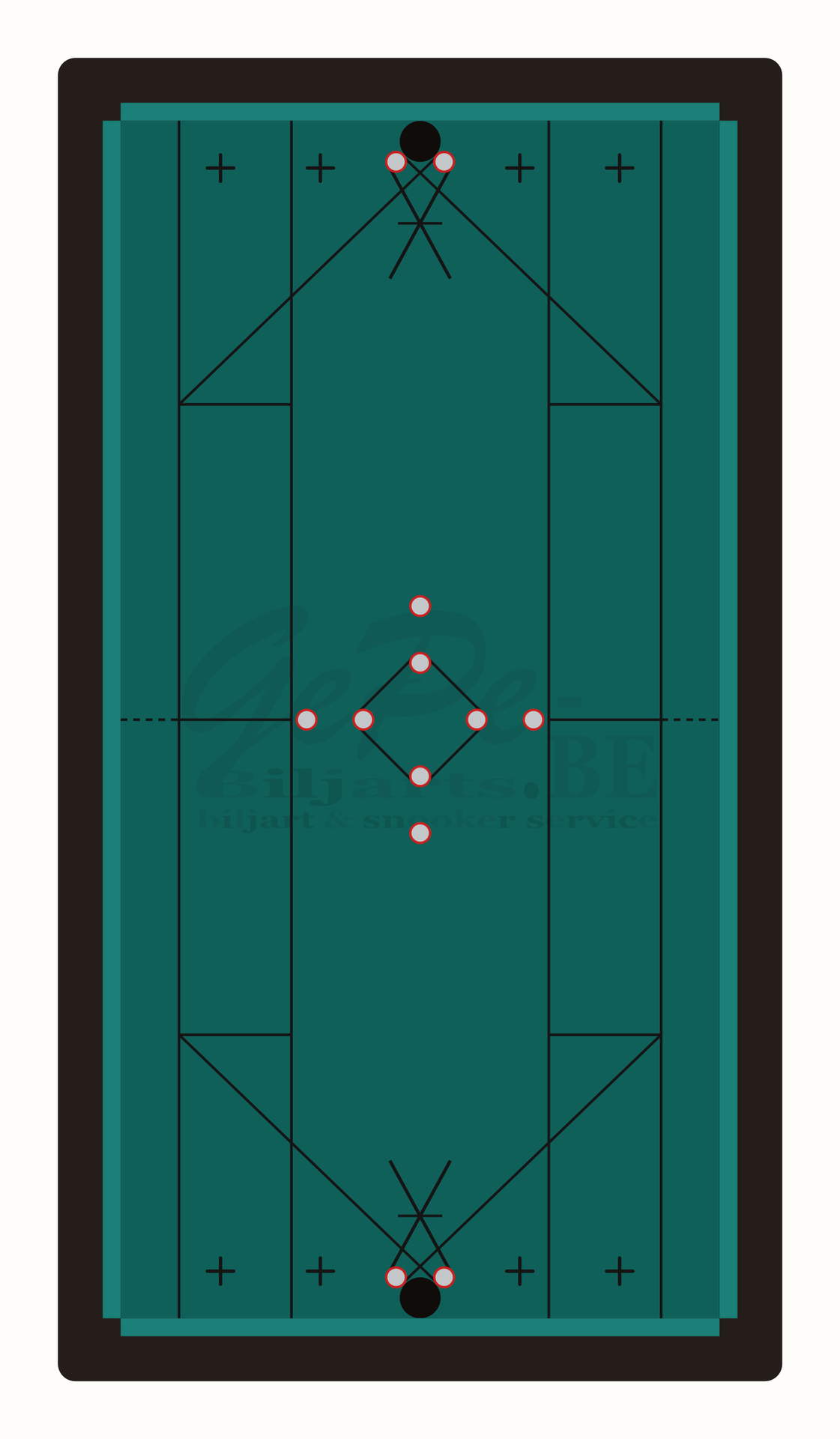
The balls
Ten balls, five per player. In competition they are 61.5 mm, white and red, made of phenolic resin, weighing 207 to 213 grams with no more than 3 grams difference within a set.
For pub and home tables that are not of match size there are smaller sets, from 35 to 57.2 mm, usually in red and yellow. Ten balls and five per player still applies; the colour and the size do not.
How you win
You win a frame by playing your five balls into your opponent's goal. A match is played to two winning frames.
Your own ball in your own goal does not count: it goes on the replacement spot and your turn is over. Playing an opponent's ball into a goal does count, but your turn passes.
The frame ends when a player scores their last ball and all balls have come to rest. If both players score their last ball, the one whose ball drops first wins.
One word that comes up often below: a replacement spot is not a point in the score but a place on the bed where a ball is replaced after an offence. Your opponent chooses which one.
Fouls
- You play with at least one foot on the floor; otherwise you lose the turn and all moved balls are put back. In zone play, the ball you played goes on a replacement spot.
- A ball wedged between the pegs of the attacking goal without touching the playing surface counts as a valid goal.
- A ball wedged between a peg and the short cushion is freed and laid loose.
- A ball wedged between the goal pegs of the defending goal is placed on a replacement spot.
- Playing directly over pegs or balls costs you the turn: all moved balls are put back and the ball you played goes on a replacement spot. Playing indirectly over pegs or balls is allowed.
- When a player sends one or more of their own balls off the table, those are placed on a replacement spot. Scoring a valid goal with that same shot costs the turn.
- When a player sends one or more of the opponent's balls off the table, those go into the goal. Scoring a valid goal with that same shot costs the turn. The ball played goes on a replacement spot.
- At 1/1, sending an opponent's ball off the table and scoring a valid goal costs the frame.
- A ball that returns to the playing surface off the wooden rail is not penalised.
- A ball that stays on the cushion, on a goal peg or on the goal cap counts as played off the table.
- If the ball is announced in the zone along the long cushion or on the line, you may not lift it over the nearest cushion. Breaking this rule costs the turn, all moved balls are put back and the ball you played goes on a replacement spot. Lifting the ball over a cushion is forbidden both as a scoring attempt and as a defensive shot.
- If a defender's ball lies in the large or the small defensive triangle, the attacker's ball may only end up in the large attacking triangle after the shot when the defender's ball is not in the small triangle after that shot. Breaking this rule puts the offending ball on a replacement spot. A ball on the line of the large defensive triangle counts as inside the triangle; this applies to both players.
Scoring
- Ball on the edge of the goal: if it drops before it comes to rest, the goal counts, even when it was played off the rubber. In all other cases it does not count: the ball is taken out of the table and put back.
- Playing one of your own balls, regularly played, into your opponent's goal counts. An opponent's ball, regularly played, that disappears into either goal counts as well.
- Playing one of your own balls into the defending goal does not count. The offender loses the turn, the ball is taken out of the table and placed on a replacement spot.
- Score a valid goal with one of your own balls and you stay at the table; score only with an opponent's ball and you lose the turn.
- More than one goal in a single shot: if a regular shot leaves one or both players without balls in play, the frame goes to the player whose last ball drops first.
Direct attempt with a ball close to the goal
- A hard, fast shot at goal is allowed when the ball lies inside the small attacking triangle or on its line, or above the shot line or on it.
- A hard, fast shot at goal is not allowed when the ball lies below the shot line, nor may you simply push the ball forward with a raised cue towards or against the goal peg. If the ball does not curve (massé) and is not first played forward and then drawn back (piqué), a hard, fast shot is not allowed. Breaking this rule costs the turn, the moved balls are put back and the ball you played goes on a replacement spot.
Aiming
- Taking up position behind an opponent's ball with the cue ready to play costs the turn. In zone play, the opponent points out a ball to be placed on a replacement spot. This does not apply when the ball to be played lies close to the opponent's ball or in the same direction of play.
- Playing with an opponent's ball costs the turn. The moved balls are put back; in zone play the opponent points out a ball to be placed on a replacement spot.
- Aiming or playing before the balls of the previous shot have come to rest costs the turn. The moved balls are put back. During zone play the ball you played goes on a replacement spot.
Touch
- A touch costs the turn, the ball you played goes on a replacement spot - even when you scored - and all other moved balls are put back. Touching a ball without playing a shot costs the turn as well, and all moved balls are put back.
- Touching one of your own balls during zone play costs the turn. The moved balls are put back, even when you scored. The ball you played goes on a replacement spot.
- Touching an opponent's ball during zone play costs the turn, all balls are put back even when you scored a valid goal, and the opponent points out a ball to be placed on a replacement spot.
- Holding back one of your own balls, nudging it or changing its direction costs the turn. The balls moved by the foul are put back and the ball you touched goes on a replacement spot.
- Holding back an opponent's ball, nudging it or changing its direction costs the turn. The balls moved by the foul are put back, the ball you played goes on a replacement spot and the ball you touched goes into the goal.
Push shot
- Keeping the cue tip against the ball until it hits another ball, a cushion or a peg costs the turn. The moved balls are put back and the ball you played goes on a replacement spot.
- The referee decides whether two balls, a ball and a cushion or a ball and a peg are touching; the touched ball may not move when you play the ball that touches it, unless you play away from it.
- You may not push through when you attempt a goal with a ball that touches the front peg or the outermost side peg of the cross and lies beyond the axis of that peg on the attacking side.
Playing on your own ball
Playing one of your own balls directly onto another of your own balls costs the turn. The moved balls are put back and the ball you played goes on a replacement spot.
Balls in the large defensive triangle
- One of your balls that lies in the large or the small defensive triangle must have left the large triangle, directly or indirectly, by the end of the turn. If it has not, it is placed on a replacement spot, all moved balls are put back and the turn is lost. A ball on the line of the large defensive triangle counts as inside the triangle.
- If several of your balls lie in the large defensive triangle, at least one must have left the triangle, directly or indirectly, by the end of the turn. If none has left, they all go on replacement spots, all moved balls are put back and the turn is lost.
Zone play
Layout of the table
For zone play the table is divided into fifteen zones. (see the drawing at the top of this page)
Start of zone play
Zone play starts as soon as one of the players has only one ball left.
Obligations
With every shot at least one ball must leave its zone, but it may come back into the same zone. Breaking this rule costs the turn and the ball you played goes on a replacement spot. All other balls stay where they are. A ball in the large attacking triangle does not have to change zone. A ball that disappears into the goal has changed zone. The large defensive triangle is not a zone for the defender's ball or balls. If a ball lies on a zone line, it is enough that it leaves the line.
Replacement spots
(the opponent chooses between 3 replacement spots)
A penalised ball goes on replacement spot 1, 2 or 3, at the opponent's choice:
Replacement spot 1: the corner formed by the goal peg and the short cushion, on the side of the offender's attacking goal, on the left. The ball must touch the short cushion and be placed 3 millimetres clear of the peg.
Replacement spot 2: the corner formed by the goal peg and the short cushion, on the side of the offender's attacking goal, on the right. The ball must touch the short cushion and be placed 3 millimetres clear of the peg.
Replacement spot 3: in the bos zone on the long axis, against the second peg on the side of the offender's attacking goal.
If the position of the other balls makes these replacement spots unusable, the penalised ball goes on the next eligible replacement spot, that is spot 4 or spot 5.
Replacement spot 4: behind and against the two pegs of the short axis, on the side of the offender's defending goal, on the left.
Replacement spot 5: behind and against the two pegs of the short axis, on the side of the offender's defending goal, on the right.
If a player plays a foul shot during zone play with a ball that lies on a replacement spot or was placed there, the ball moves to the first available replacement spot from which no foul shot has been played yet.
Duo matches
The opening shot
Before the first frame each duo decides who takes the opening shot. In the second frame the other player starts; if that is not respected, the turn is lost and the ball played goes on a replacement spot. In a deciding frame each duo decides again who takes the opening shot. The duo whose ball comes to rest closest to the goal stays at the table and the second player continues, unless the opening shot scored a valid goal.
Order of play
Players take turns. If the order is not respected, the turn is lost and the moved balls are put back, even when a goal was scored. During zone play the ball played goes on a replacement spot.
Consulting each other
Team-mates may consult each other about how to play, but they may not point at or indicate anything. One player's play may not be influenced by the other, neither by word nor by gesture. This means the team-mate stays at least 1 metre away from the table and from the player at the table during the turn, and stops consulting once the shot is being played.
Length of a turn
A turn lasts 50 seconds, counted from the moment the balls of the previous shot come to rest. The referee calls "TIME", after which the shot must be played within 10 seconds. Breaking this rule costs the turn. During zone play the opponent points out a ball to be placed on a replacement spot.