The game
In 9-ball you play the balls in numerical order: the 1 first, then the 2, and so on. Whoever legally pockets the 9 wins the rack — even if that happens on the break.
The rack
The nine balls are racked tightly in a diamond. The 1 goes at the front, pointing towards the head of the table, and the 9 sits in the middle of the diamond, on the foot spot. The rest go in without any pattern.
The 9 on the foot spot is the NEW rule: that is how the WPA rules have read since 15 September 2025. Until then the 1 sat there, and that is still what you see in older books and videos. The whole rack therefore moves two rows towards the head of the table — about ten centimetres.
The break
Whoever wins the lag breaks. You place the cue ball behind the head string and you have to hit the 1 first. The break counts if a ball is pocketed, or if at least four object balls reach a cushion. If neither happens it is a foul and the turn passes.
Pocket the 9 on the break and you have won.
The break box
In official 9-ball the cue ball may not be placed anywhere in the kitchen for the break, but only inside a marked area: the break box.
foot spot and line
In 9-ball that long line has a clear job. If the 9 has to come back onto the table — it drops on a foul or on a push out, or it is driven off the table — it belongs on the foot spot. If another ball is in the way, it moves back along that line, towards the short rail, as close to the foot spot as possible.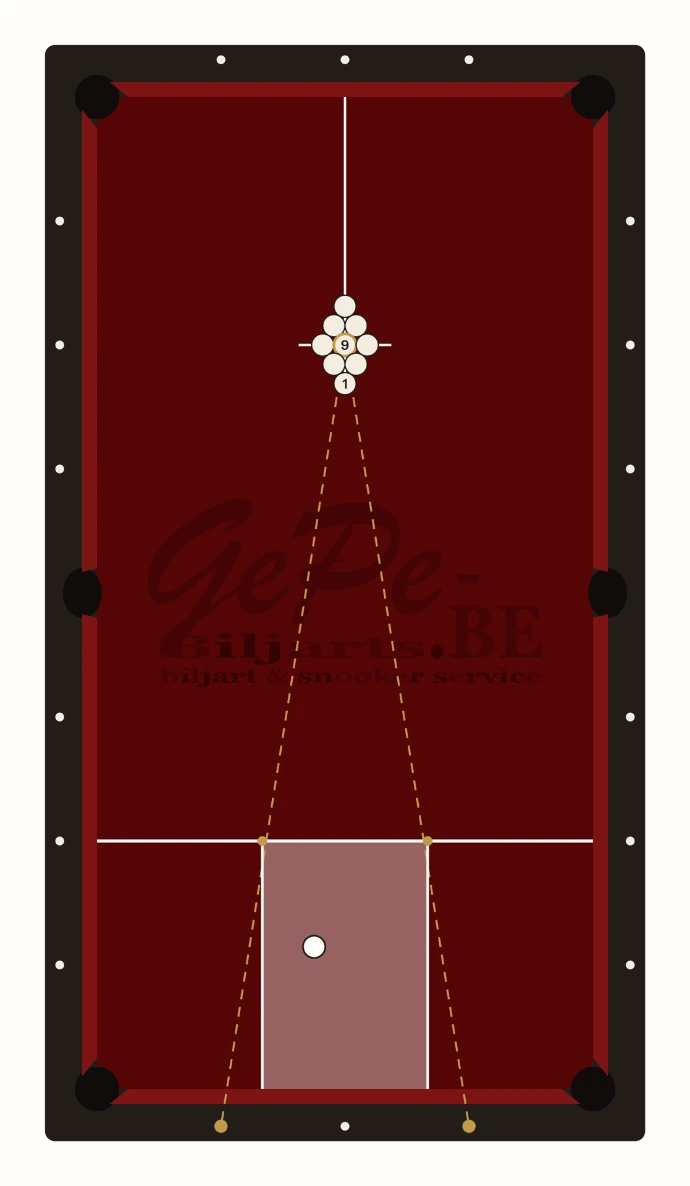
Push out
Straight after the break the player at the table may play one push out. You announce it, and then you may send the cue ball wherever you like: you do not have to hit the lowest ball first and no cushion has to be reached. Your opponent then chooses whether to take the shot or hand it back to you.
It exists for the position where the break leaves you with nothing.
Order of play
You always have to hit the lowest ball on the table first. What drops after that does not matter — a combination counts too. Pocket a ball and you carry on. Miss, or foul, and it is your opponent's turn.
Fouls
- pocketing the cue ball or driving it off the table
- hitting the cue ball with anything other than the tip
- hitting the cue ball twice
- pushing the cue ball instead of striking it
- not hitting the lowest ball first
- no cushion reached after contact, with no ball pocketed
- driving a ball off the table
After a foul your opponent gets ball in hand: the cue ball may be placed anywhere on the table, not just behind the head string.
If the 9 is pocketed on a foul it goes back on the foot spot and play continues. Any other ball pocketed on a foul, or driven off the table, stays off.
No open table
Unlike 8-ball, there is no open table in 9-ball. You always have to hit the lowest ball first, whatever went down on the break.
How the game ends
The rack is over as soon as someone legally pockets the 9. It does not have to be the last ball: hit the lowest ball cleanly and send the 9 in with it, and you win on the spot.